The Early Years
1900 to 1941
Revelstoke had a significant Japanese Canadian population in and around the city in the early 1900s, but they were a largely hidden community. Newspaper accounts of their lives were mostly restricted to violent deaths, or criminal activity.
Official records give us some clues as to the people who were here.
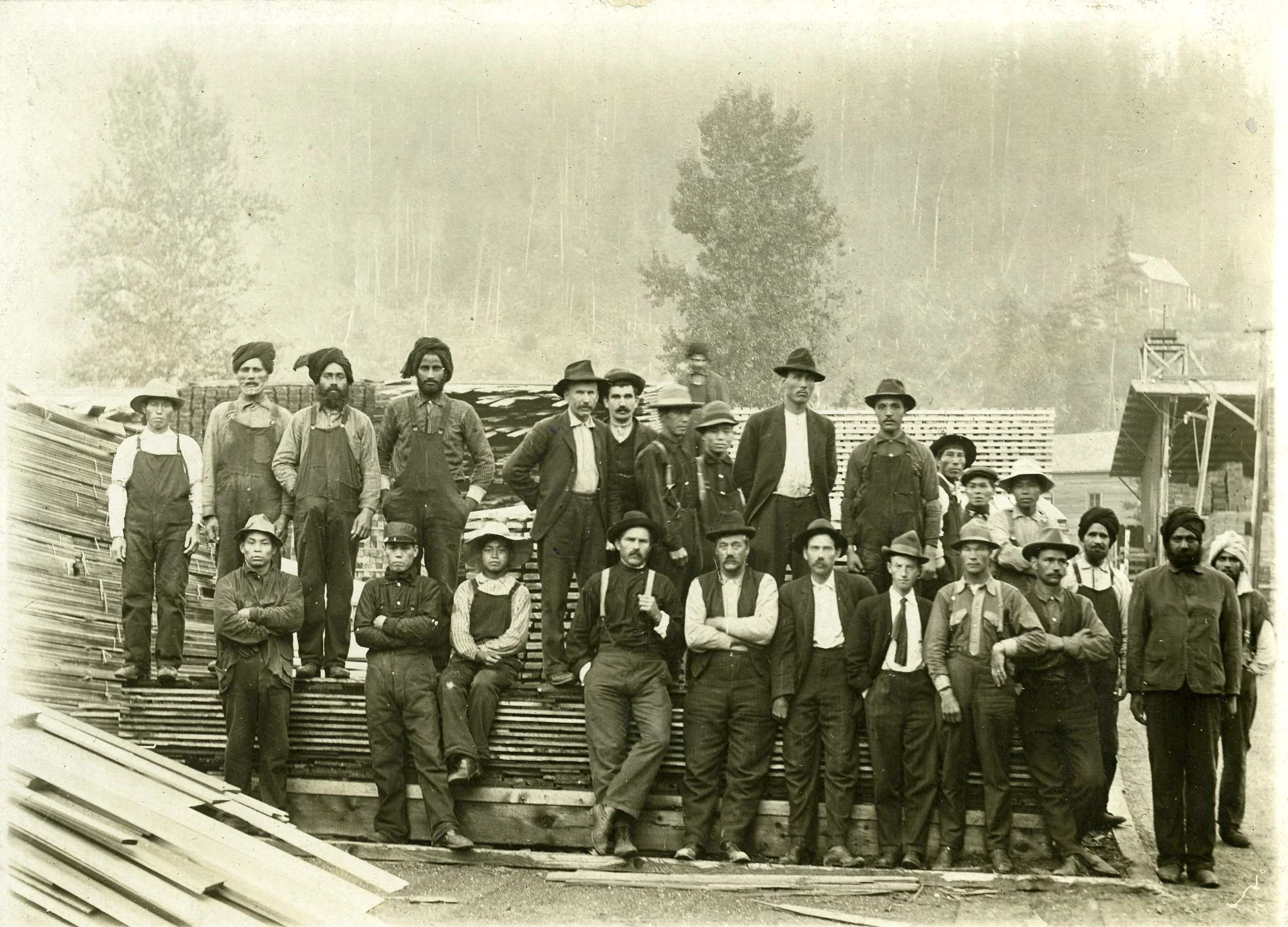
Lumber Crew at Comaplix, ca. 1910. P-2245.
The 1901 census lists 19 Japanese Canadian men in the region, with 17 of them at Illecillewaet, and two at Arrowhead. All of them were listed as labourers.
Ten years later, the 1911 census records 144 Japanese Canadian people, including some women and children, living at Malawka, Taft, Three Valley, Arrowhead, Comaplix, and just east of Revelstoke on the railway right of way. Almost all of them were working on railway labour gangs, or in sawmills. The Nippon Supply Company was a labour broker firm that employed the majority of the Japanese workers and arranged for crews to be available for jobs.
In 1911, Masatora Tamemura, age 33, was living at Three Valley with his wife Uno Soga, and Utaro Kakamura lived there with his wife his wife Otala, and their six-year-old son Takagi. Masatora and Utaro were among the many Japanese Canadian workers at the Mundy Lumber Company Sawmill.
Vital events records show that 79 Japanese Canadian people died in Revelstoke and the surrounding area between 1904 and 1936, including the March 4, 1910, Rogers Pass avalanche that took the lives of 58 men, including 32 Japanese Canadian labourers. Of those people, fewer than 25 were mentioned in the local newspaper, and many of those did not include the name of the person who died, such as this article from the Revelstoke Mail-Herald from August 8, 1914.
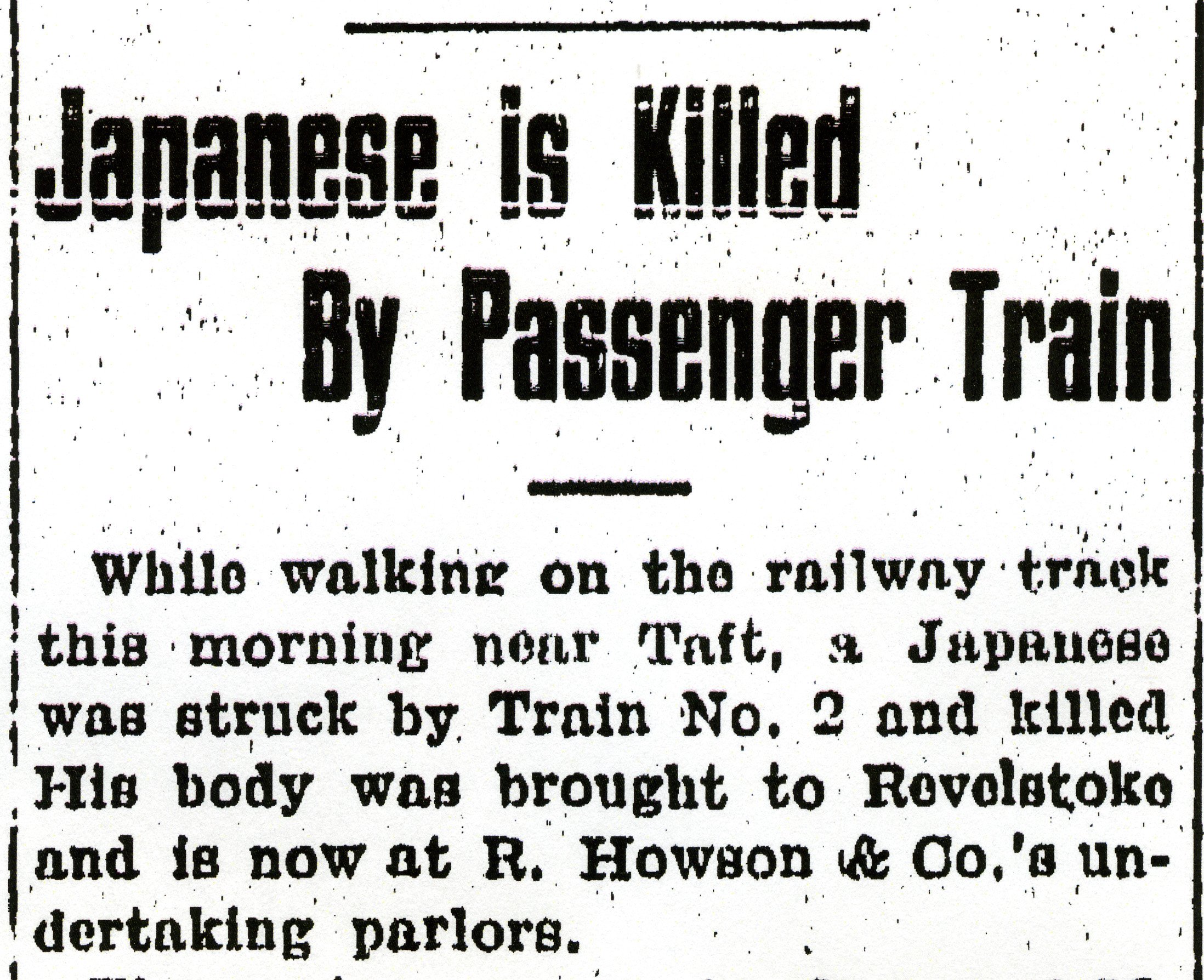
From Revelstoke Mail-Herald, August 8, 1914.
“Japanese is Killed by Passenger Train.
While walking on the railway track this morning near Taft, a Japanese was struck by Train No. 2 and killed. His body was brought to Revelstoke and is now at R. Howson & Co.’s undertaking parlors.”
The BC Archives vital events index revealed his name as K. Miyashita, age 32. He was possibly from Nagano. He is buried in an unmarked grave at Mountain View Cemetery in Revelstoke. The next edition of the newspaper reported that 15 Japanese from the neighbourhood of Taft, where he lived, attended the funeral in Revelstoke. The paper still did not mention his name.
An avalanche in April of 1908 took the lives of four Japanese Canadian men who were sleeping in their boarding cars on the Canadian Pacific Railway tracks at Downie siding, 24 kilometres east of Revelstoke. The four boarding cars had been switched to a siding that was believed to be clear of former slide paths in that area, but a slide came from a different direction and hurled the boarding cars off the tracks. Four of the men were smothered to death in the snow, and six others were badly bruised and shaken up. The fatalities were Kametaro Kurashita, age 31 from Kagoshima; Fusataro Kurisaka, age 37 from Okayama; Seiichi Saito, age 26 from Okayama; and Zentaro Aoki, age 30 from Kagoshima. All of them are buried in Revelstoke’s Mountain View Cemetery.
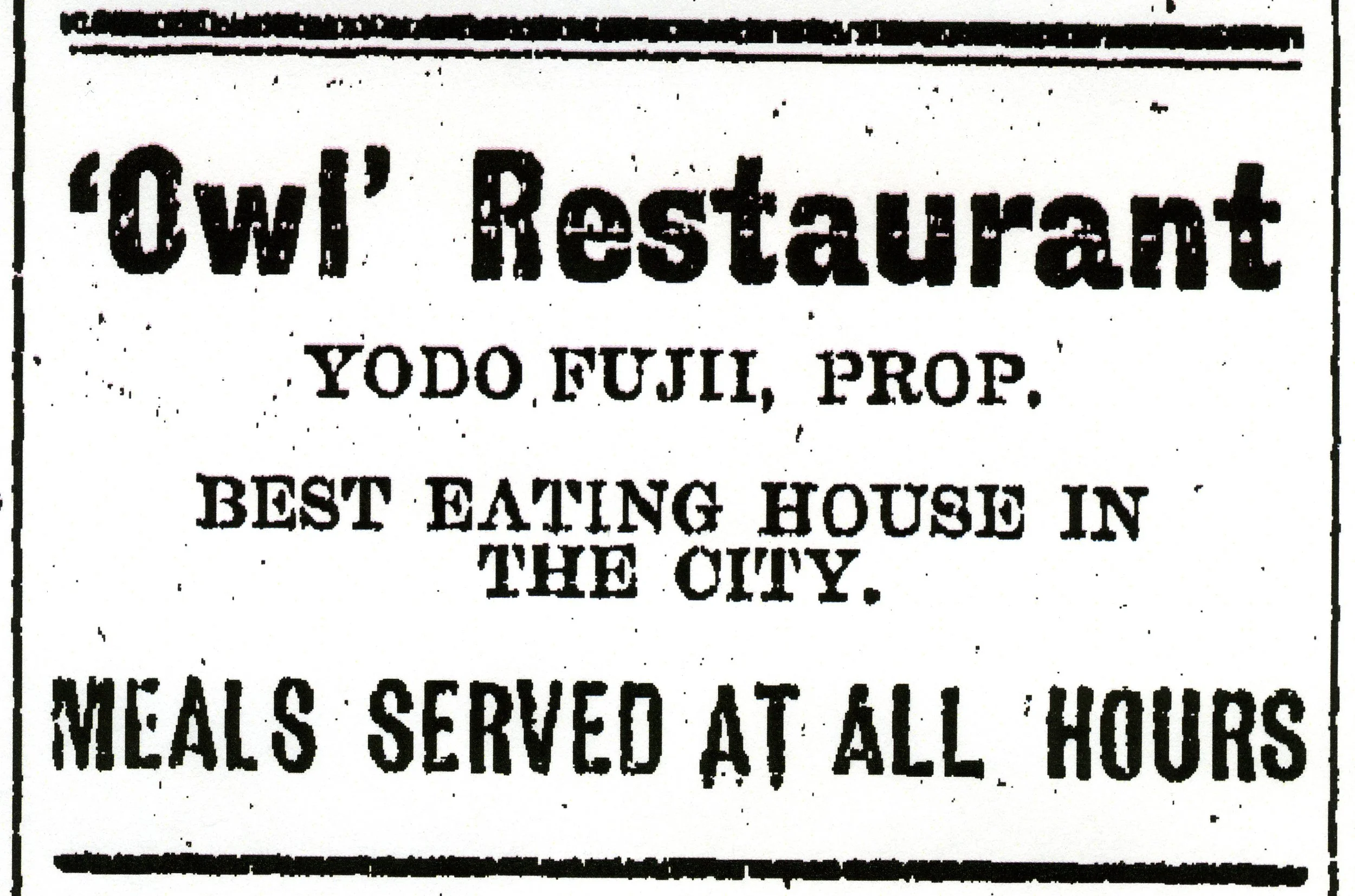
A man named Yodo Fujii operated the Owl restaurant out of the bottom storey of a boarding house at 201 First Street East, at the corner of Orton Avenue. The restaurant appears to have been short lived, as the ads only appeared between March and September of 1904. It was advertised as the “Best Eating House in the City”, with meals served at all hours.
Kusumatsu Shiosaki worked as the farm manager for C.B. Hume’s ranch near Williamson’s Lake, south of Revelstoke, where he lived with his wife Tora. Daughter Mary was born in Revelstoke in 1911 and son Nelson in 1913. Shiosaki grew apples, strawberries, rhubarb and other produce for C.B. Hume’s Department Store in Revelstoke and won prizes at fairs all over western Canada. The family later moved to Kelowna, but Nelson died just north of Revelstoke in 1959 while working for the West Columbia Placer Mining Co. of Kelowna.
Choichiro Takahashi was in Revelstoke by 1910, working as a section foreman with the Canadian Pacific Railway. He and his wife Sue had several children, and two of his sons worked as bakers for Gallicano bakery. Ryozo, known as Leo, owned the business for several years, and lived on Second Street West. Five generations of the Takahashi family lived in Revelstoke between 1910 and 2007.
The Spanish Flu pandemic hit Revelstoke in the fall of 1918, and 36 people in Revelstoke died, including six Japanese Canadians. Inosuke Tsuzi, age 32, died at the end of October 1918. Tomi Irene Hashimoto, age 30, and Hatsu Lily Morikawa both died in November 1918. The women were believed to be sex workers, and they owned a house together on Douglas Street. A man named Tashiro Shigaya, section foreman at Twin Butte, east of Revelstoke, died on November 8 at the age of 38. Two boys with the last name of Shigaya, 5-year-old Eichiro, and 3-year-old Masuo died at the end of December. We believe that they were the children of the late Tashiro Shigaya and his wife Masu. Matushiro Tanaka, age 30, died at Greely Creek, east of Revelstoke, on November 18, 1918.
Tomi Hashimoto and Hatsu Morikawa were not the only Japanese Canadian sex workers in Revelstoke. The Revelstoke City Police charge book records approximately 24 women of Japanese origin who were brought up on charges relating to sex work between the years 1899 and 1905. It is hard to be precise about numbers, because it is possible that several names were misspelled, and two separate spellings could have been one person.
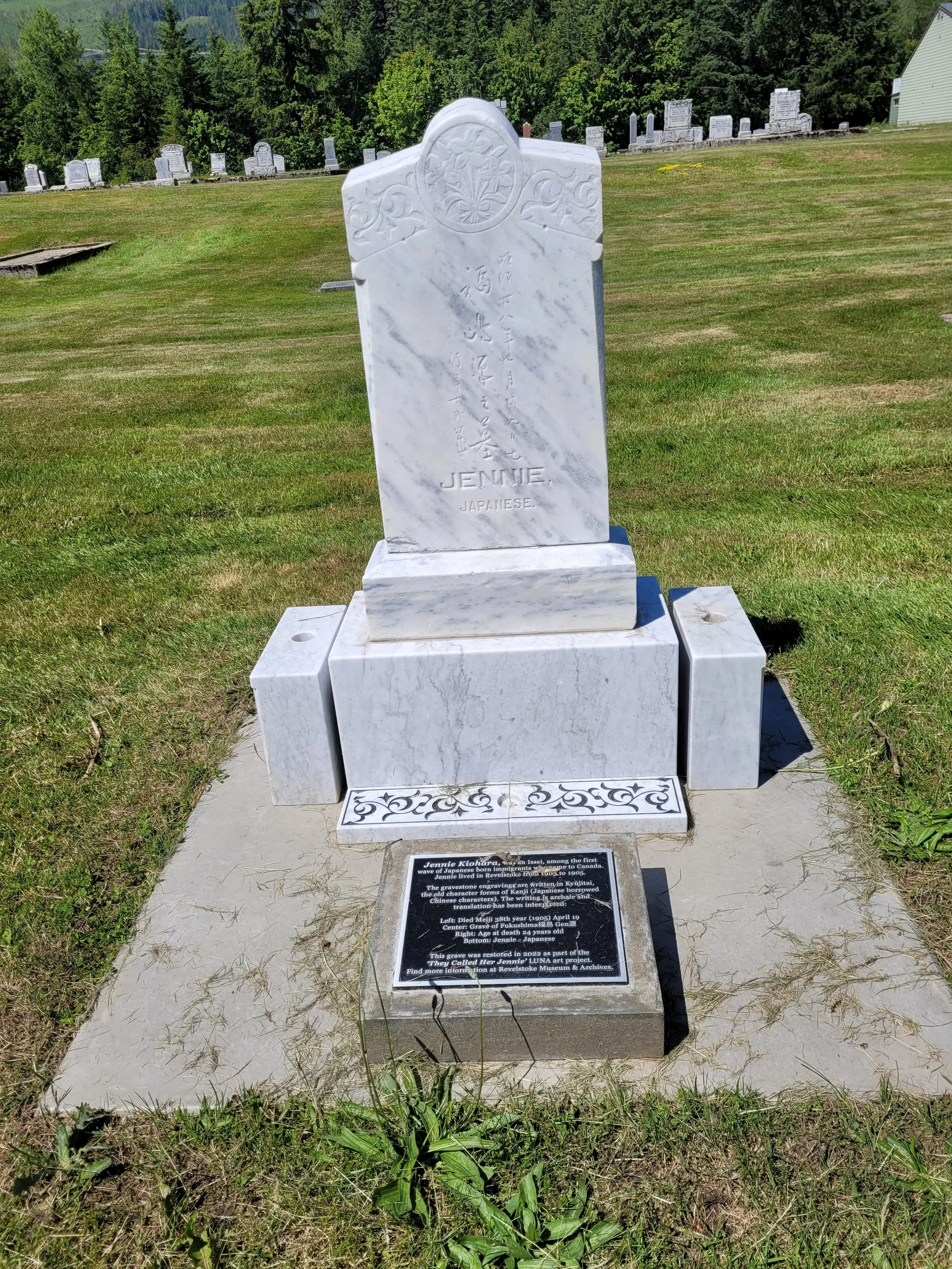
Jenny Kiohara’s gravesite at Mountain View Cemetery, Revelstoke, after restoration in 2023.
Among the women charged with sex work was Jennie Kiohara. Her name appears in the police charge book by the spring of 1903, when she was brutally attacked by a white man. She appears three more times over the next two years, charged with being a “keeper,” which means that she maintained her house, and possibly had other women working for her. On the morning of April 19, 1905, she was found dead in her own home, murdered by a knife-wielding assailant. A man named S. Fukushima, who is sometimes referred to as her husband, was brought in for questioning but soon released. The murder was never solved. In 2023, her grave marker was placed on a new pedestal, and in May of 2025, Rev. Naoki Hirano of Kelowna, BC blessed her grave.
A woman named Jenny Kagawa also appears in the police charge book. The city tax records show that Kagawa owned property on Douglas Street between 1906 and 1918. Kagawa is believed to be Tsuru Kagawa, who was referred to as being very wealthy and influential in an article published in Tairiku Nippo, a Japanese language newspaper, on November 23, 1908.
On March 2, 1936, a railway crew was working to clear a major snowslide on the railway line at Illecillewaet, 42 kilometres east of Revelstoke. The sides of the slide were up to 4.5 meters above the track as the crews were clearing it. An engine crew was pulling the tender from a wrecked engine away from the site, and as the locomotive headed up a steep grade, the tender became uncoupled, and ran down the mountain grade to the site of the snowslide, where many men were still working in the cut, which could be described as a trench created after the railway snowplough went through the slide. Trainmen, officials, and laborers were trapped between the high walls of snow.

Jisaburo and Tane Mizuta with son Haruji next to a CPR Boarding Car, 1933. P-13701.
Sixteen men were killed in the accident, including Yonezo Ikeda, age 42; Sosaburo Hidano, age 57; Shukichi Mitsuzumi, age 47; and Nenokichi Nagamori, age 61. Jisaburo Mizuta, a bookman for the crew, heard the rumbling of the approaching tender, and was able to quickly step to the side. He felt a very strong wind pass beside him, and tried to get up in the snow, but could not move at all. He lost consciousness and woke up on the way to the Queen Victoria Hospital. He suffered from a broken leg which never properly healed. While he was still in the hospital, his wife Tane was admitted, and gave birth to their second child, a daughter, on March 23, 1936.
*From “Exploration of Devil Caves”, published in Tairiku Nippo, November 19, 1908 to February 13, 1909. Translated at UBC by Ayaka Yoshimizu, edited by Julia Aoki.