Introduction
The history of Japanese Canadians in Revelstoke dates back to the late 1890s and early 1900s, with many of the early arrivals working on the railroad or in sawmills.
A 1904 newspaper advertisement mentions the Owl Restaurant, owned by Yodo Fujii, located at First Street and Orton Avenue. The restaurant appears to have been very short-lived. The earliest record of Japanese burials dates to 1905, and surprisingly, the burials include sex workers. This indicates the presence of Japanese people in Revelstoke from this period.
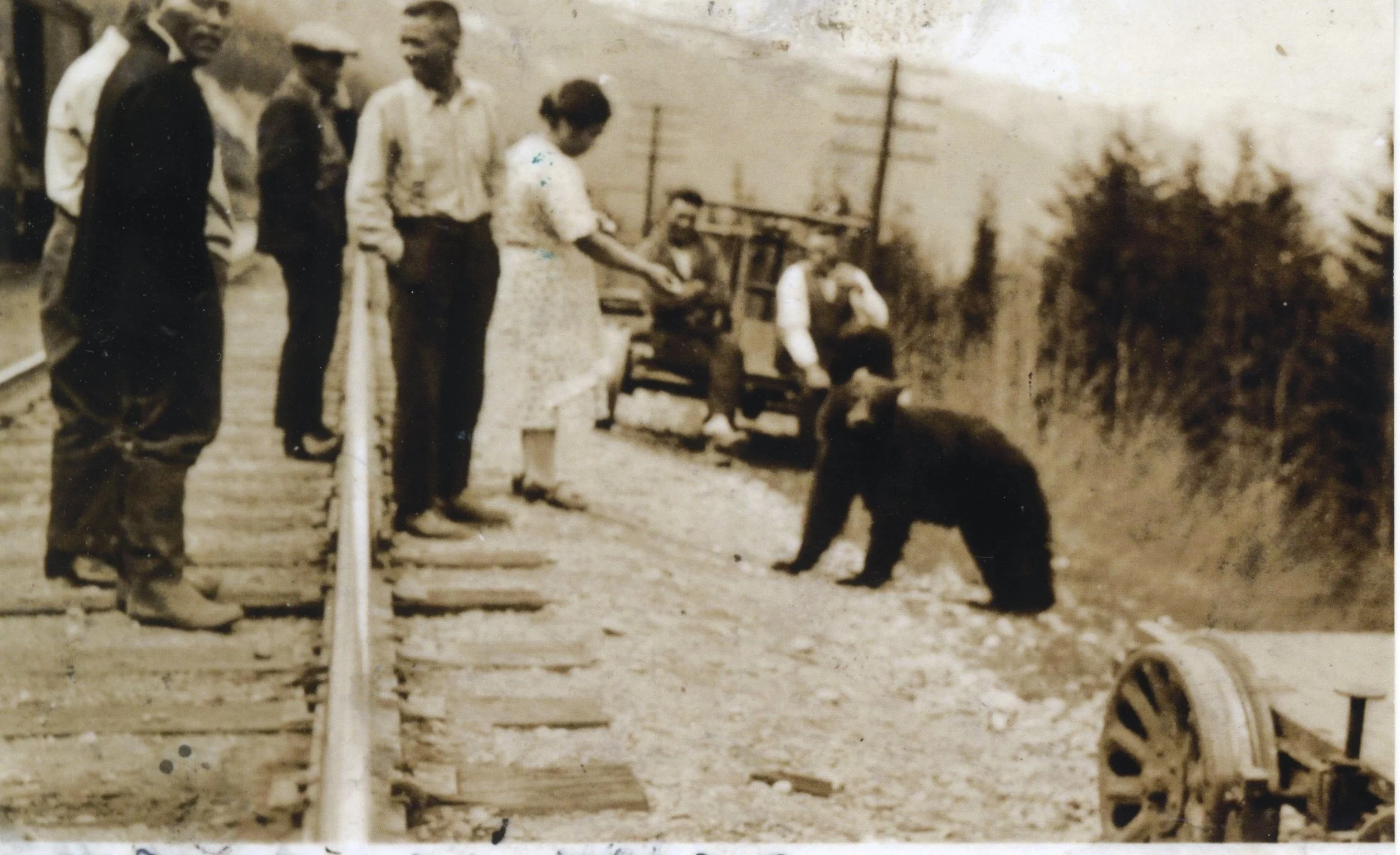
Hisa Hashimoto feeding a black bear cub near the railway tracks. P-13680.
Many of the Japanese Canadians living in and around Revelstoke at that time were men, either married or single without their families, but there were also several families living here, including the Hashimoto and Takahashi families.
In 1910, the infamous Rogers Pass avalanche killed many Japanese railroad workers. Around this time, newspaper articles mention the existence of a Japanese Boarding House on First Street East, and Japanese people selling alcohol.
During the First World War, a number of Japanese Canadians served in the war. Kiyoji Migita, father of Tsutomu Migita, who later moved to Revelstoke, and Yashichi Saito were among those soldiers.
The declaration of war against Japan by Canada and the other Allied countries on December 8, 1941, marked the beginning of one of the most difficult times for Japanese Canadians.
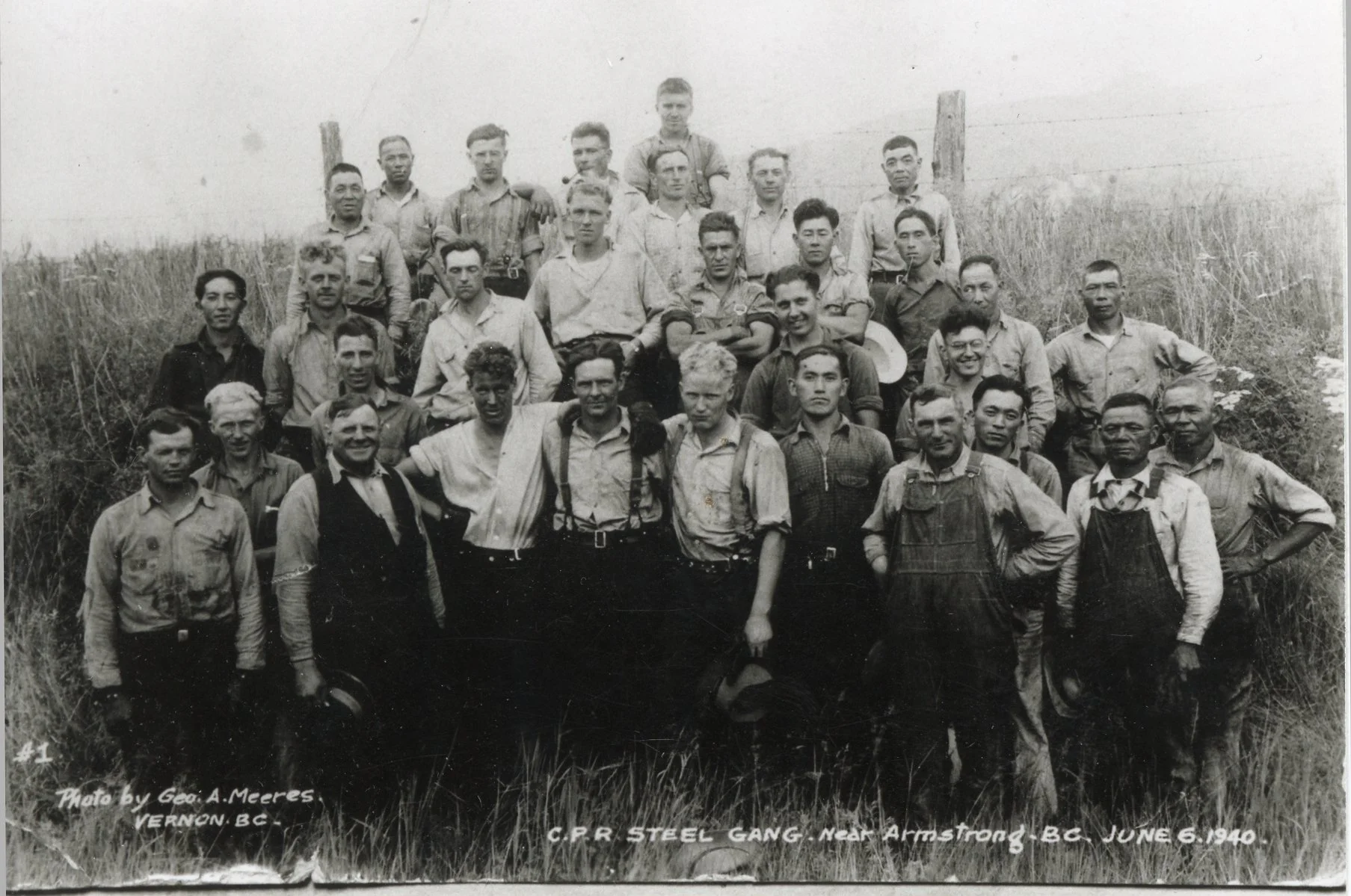
CPR Steel Gang near Armstrong, 1940. P-14172.
The Canadian Government enacted the War Measures Act, stripping Japanese Canadians of their civil liberties, property, and possessions, including fishing boats. Japanese Canadians were registered and treated as enemy aliens and classified as Japanese Nationals, Naturalized Canadians, or Canadian Born Citizens. A Federal Order in Council in February 1942 designated the entire British Columbia coast – a 100-mile-wide protected zone stretching the full length of the province – a “protected area” and began to forcibly remove Japanese Canadians, sending them to internment and self-supporting camps in BC and labour projects in BC and Ontario, with some sent to work the sugar beet fields in the prairies. Japanese Canadian-owned property was to be held by the Custodian of Enemy property, but later in 1943 was sold off without their permission.
The forced uprooting led to the relocation of approximately 60 families to Revelstoke. Those who could live without government assistance, or who had relatives or acquaintances already in Revelstoke, were allowed to live in this area, but only outside the city limits. When the internment camps closed and the second forced uprooting to Japan or east of the Rockies occurred, additional families came to Revelstoke.
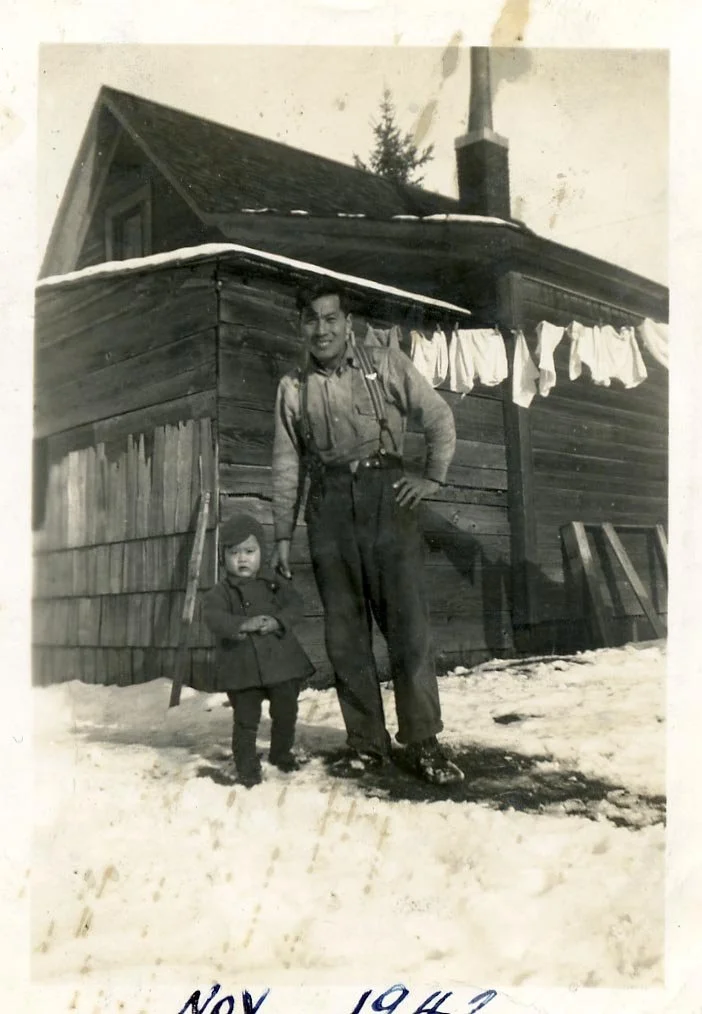
Seiji (Stan) Imada with his father Morio Imada at their home in Big Eddy, November 1942. P-12759.
According to survivors, the conditions in Revelstoke were not as poor as for those who lived in the internment camps, but city bylaws still prohibited them from living within the city limits. At that time, the Big Eddy community on the west bank of the Columbia River was outside of the city, as was the area south of Downie Street, in the Southside neighbourhood. These areas became havens for the uprooted Japanese Canadians who came here.
During the Internment period, many Japanese Canadian men were forced to work on the highway construction road camps between Revelstoke and Sicamous. On their days off, they were allowed to come into Revelstoke.
For a while, some families in Revelstoke made a living growing strawberries, while others worked as carpenters, accountants, tailors, and mechanics for local companies.

Japanese Canadian Citizen Association’s annual concert in St. Francis Hall, 1949. Yukino Kono playing the Biwa. P-14215.
In 1947, permission was granted to Japanese Canadians in Revelstoke to purchase businesses and homes within city limits, and several Japanese Canadians started their own businesses. Members of the Revelstoke Branch of the Canadian Legion tried to convince City Council not to issue licenses to Japanese business owners, but in a split decision, City Council did agree to the issuing of business licenses. In 1945, with a Caucasian partner who was able to obtain a business license, Roy Shoji started the Snow White Laundry at Garden Avenue. Shoji relocated his business in 1947 under his own name.
Since then, Japanese Canadians have taken root in the Revelstoke community, and as of 2025, second and third generations are still settling here. At the same time, the number of new Japanese immigrants is increasing.
We would like to take this opportunity to pay tribute to the Japanese Canadian pioneers who overcame hardships and lived their lives with dignity in Revelstoke.